
The first step out of bed is the tell. Not the second, not the tenth. That one step onto the carpet before I am properly awake, and the left heel sends up a complaint that has nothing to do with how I slept. Mine started in October 2025. By December, Dr. Okafor had a name for it and two plain instructions: stretch the calves, and put better support under the foot.
I started with the wall stretch, because it was free and I already owned a wall. It helped some evenings. It did nothing for my mornings, mostly because at 6:10 a.m. I am not going to stand in a hallway with both hands on the paint and my back leg straight for a full minute. I wanted something I could do in the bathroom with one hand on the counter, half asleep, without arguing with myself about it. In February 2026 I bought the ProStretch calf stretcher, one rubber foot rocker, and set it on the bathroom floor beside the counter.
This is not a review of whether the thing works. It is the routine itself: what I do with it and in what order, the parts I got wrong in the first two weeks, and what else did and did not help a 59 year old woman who stands on concrete for a living.
The stretch I actually do is the one that lives where I already stand
Mine sits on the bathroom tile because that is where I am at 6:10 in the morning, half awake, with bare feet. One hand on the counter, three holds per leg, then shoes. It came into the house in February 2026 and it has not moved since.
Amazon Check Today's Price on Amazon →Step 1: Put it where you already stand, not where you mean to stretch
I had good intentions about a stretching corner in the back bedroom. That would have lasted a week. The bathroom is the one place I am guaranteed to be every morning, with bare feet and thirty spare seconds, so that is where the ProStretch went: on the tile, beside the counter, close enough that my right hand lands on the countertop without taking a step. That last detail matters more than it sounds. If I have to walk to it, I will not.
Two notes about the floor. The unit has rubber strips on the bottom and they hold on bare tile. On a damp bath mat they do not, so mine sits on the tile and the mat gets pushed aside with my foot. If your bathroom has carpet, or a rug in front of the sink, that is the thing to move. The listing also gives a recommended weight limit of 250 pounds, which is worth checking before the first morning rather than after it.
It weighs 14 ounces and measures about 6 by 12 by 8 inches, so it does not need to claim much of the room. I have knocked it into the tub once in nine months and put it back. Don, who is retired and therefore in the house when I leave, has learned not to shift it when he cleans the floor. That sounds like a small thing. It is the difference between a routine and a search every morning.
Step 2: Set the ball of your foot high and keep the heel down
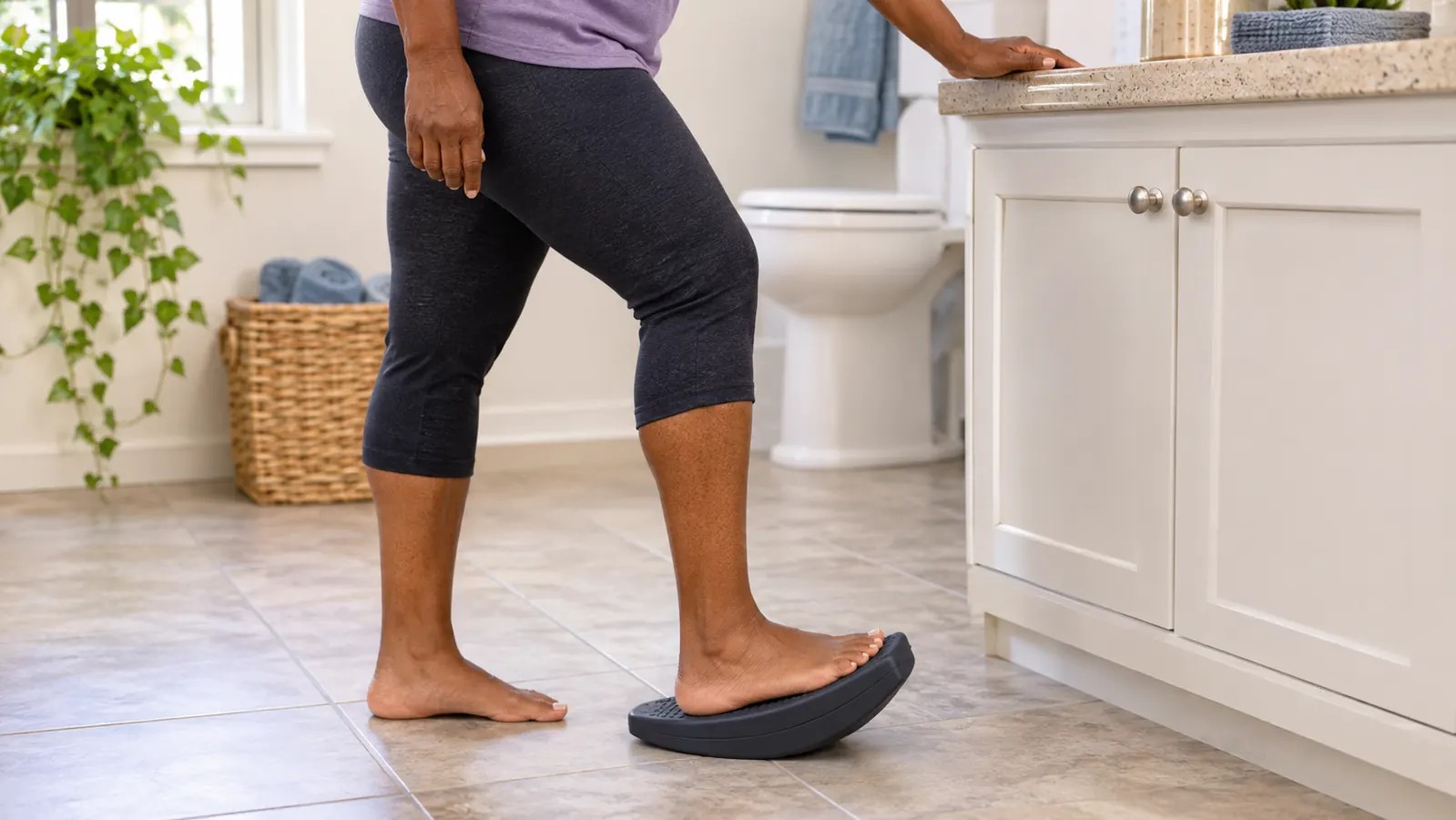
The ProStretch is a rocker, not a wedge. The ball of your foot goes on the raised front and your heel settles into the curve behind it. The first week I put my whole foot flat on top and balanced there like it was a step stool, which does nothing at all. The stretch only happens when the heel is low and the ball of the foot is high, and it took me a while to feel the difference.
Start with the leg that is not bothering you. Mine is the right. It gives you a free lesson in where the foot sits before you ask the sore side to cooperate, and the sore side has less patience for being arranged. My left foot took the position more slowly for the first two weeks and I let it. Nothing about this is a race and there is no prize for getting the heel lower on day one.
The listing says it fits adult shoes up to size 12. I use it in bare feet, which is how it ended up in my morning, and I have never tried it with the sneakers on. If you plan to wear shoes on it, that is the number to keep in mind. In socks the surface is rubber and the sock slides a little, so settle the foot first and lean after, not both at once.
Step 3: Hold 30 seconds, three times per leg, before your shoes go on
This is the whole program. Three holds of 30 seconds on each leg, before the sneakers go on. It takes about four minutes if I am not dawdling, and less than that if I am counting badly. There is no second exercise and no extra set. Five steps sounds like a lot until you notice that four of them are just how to do the first one properly.
I count, because otherwise 30 seconds becomes 12. Some mornings I count out loud, which is not dignified and works anyway. Three separate holds do more for me than one long one. In the beginning I tried a single hold of 90 seconds and skipped the rest, which was less useful and far easier to talk myself out of on a cold morning. Three small commitments are harder to abandon than one big one.
The timing is the part I would keep if I could only keep one thing. Before shoes, before the walk out to the truck, before the concrete floor at the store. That is why the evening version never took. By 7 p.m. my feet have had a full day and I have a hundred reasons to be somewhere else. If your mornings are loose, the anchor is still the shoes. The point is that the stretch happens before the foot has to work, not that it happens at a particular hour.
Step 4: Stand tall, one hand on the counter, and do not bounce
The temptation is to lean hard and pump. Bouncing feels like you are getting somewhere. It is also how I tweaked the back of my left ankle in the first week and had to leave it alone for a few days, which cost me more than the bouncing ever gave me. Steady pressure, hold, come up slowly, switch sides. That is the whole technique.
Posture matters more than I expected. Hips over the middle of the unit, one hand on the counter, the other arm loose at your side. I spent the first month hunched forward like I was reading something small, which put my weight in the wrong place and quietly shortened the stretch. Standing up straight was the entire correction. Nobody told me that. I noticed it because my lower back was complaining on the tile.
Then the rule I do not bend. If something pinches, tingles or goes numb, stop. That is not a stretch and it is not a thing to work through. Sharp pain goes to a doctor. Numbness, swelling, a sudden injury, or pain that will not settle also goes to a doctor. Dull pulling that eases the moment you come off the unit is the sensation you are after. I am not qualified to tell you anything past that sentence.
Step 5: Give it four weeks before you form an opinion
My calves felt looser after about four weeks of doing this every morning. Not after three days. Four weeks of a four minute habit is roughly 112 minutes of standing on bathroom tile, which is a fair price for finding out whether it does anything for you. I would have quit at ten days if I had been judging it by feel, because at ten days there was nothing to feel.
The other thing that happened in those four weeks is that it stopped being a decision. By March it was simply what happened between getting out of bed and putting shoes on. A thing you do without deciding is worth more than a thing you do perfectly twice a week and skip the rest. That is the only reason it is still part of my morning nine months later.
What I will not tell you is that it fixed my heel, because it did not. Most mornings now the first steps are a mild ache rather than the sharp stab of last winter. Better is not gone. I credit the whole set of habits, the insoles, the sandals, the mornings, and not one item on the tile. If nothing has changed after a month of doing it most days, that is information too, and it is worth taking to someone with a diploma.
What Else Helps
Stretching was one of two things Dr. Okafor gave me in December 2025. The other was better support, and that turned out to be the insoles in my work sneakers rather than anything on the bathroom floor. I bought the PCSsole insoles in the first week of January 2026 and trimmed them along the cutting line to fit the sneakers. The arch felt odd for a week. By week three, the end of a shift felt easier. Those live in the work sneakers every shift and nowhere else. I do not put them in anything else and I would not.
At the store I keep a wooden foot roller under the back office desk and use it at lunch with my shoes off, five minutes or so. It feels good for an hour and I claim nothing lasting from it. It is a break, not a treatment. On days off I am in plain cotton crew socks around the house, and the slide sandals I bought in May 2026 sit beside the bed so the first steps of the day land on those instead of tile. That is comfort, and I am not going to dress it up as more than that.
The wall stretch did not disappear. I still do it some evenings in the hallway, mostly because it costs nothing and it works a different angle than the rocker. They have separate jobs now. ProStretch is the morning, the wall is the occasional evening, and the wooden roller is at work. When I let those blur into each other I ended up skipping all of them for about a week last spring.
Most mornings now the first steps are a mild ache rather than the sharp stab of last winter. Better is not gone.
One more thing, and it is the honest one. Everything above describes one woman's left heel, one store's concrete floor, and one routine. Feet differ, and the thing that makes my mornings milder may do nothing for yours. I never saw a podiatrist, never had imaging, never wore a night splint, and I am not in a position to hand anyone a diagnosis.
Four minutes on the bathroom tile, before the shoes go on
This is the one piece of my routine that never needed a reminder, because it sits beside the counter where I already stand. Nine months in it is still the first thing I do. Today's price and the listed fit are on the Amazon page.
Amazon Check Today's Price on Amazon →