

I bought the PCSsole insoles in the first week of January 2026 with my own money and no particular hope. My left heel had been hurting since October 2025. The right foot has never hurt once. Mornings were the worst part: the walk from the bed to the bathroom is maybe a dozen steps across tile, and the first three of them felt like stepping on a stone that was not there. Dr. Okafor, my family doctor, told me in December to stretch my calves and put better support under my feet. So I started with the cheap thing first, a pair of drugstore gel insoles, and gave up on those after about three weeks.
That is how I came to order PCSsole. I am the office manager and floor lead at a family hardware store in Medford, Oregon, and I have spent fourteen years on my feet on a concrete floor, Tuesday through Friday, eight to five, with a small desk in the back office for the paperwork. Concrete does not forgive anything. What I wanted was not a cure. I wanted the last two hours of a shift to stop being a countdown. Here is what ten months of daily wear taught me, what the insole is actually built like, and who I think should leave it alone.
The Quick Verdict
Firm, high arch, and genuinely useful under a long shift on concrete. It is not soft, the first week is unpleasant, and it will do nothing for you if what you want is cushioning.
Amazon Check Today's Price →The insole that has been in my work sneakers since January
One pair, trimmed once, worn every shift for ten months. If your heel complains on the first steps of the morning, this is the version I would start with.
Amazon Check Today's Price on Amazon →How I've Used It
One pair, bought in the first week of January, and it has lived inside the same pair of plain lace up work sneakers ever since. I did not rotate it. I did not put it in a second shoe. The sneakers go on at ten to eight and come off around half past five, four days a week, and the insole has been in them for every one of those shifts. I trimmed it once, on a Monday evening at the kitchen table, following the guide molded into the underside, using Don's heavy shears because mine would not go through the heel section cleanly. I laid the old foam liner on top of it as a template, cut a little wide of the line, then took it down in small passes until it sat flat with nothing curling at the toe. I have not touched it since, and I have not had to.
That is worth saying plainly, because a lot of reviews describe a product in a life it does not have. Mine is narrow. It is a concrete floor, a stockroom, a register, a counter, and about eleven thousand steps on an average Tuesday according to the phone in my pocket. I am fifty-nine. I am not a runner, a hiker or a gym person and never was. Since June my husband Don and I walk a paved loop of a mile and a half on Sunday mornings, and that is the most athletic thing on my calendar.
I also want to be clear about what I noticed and what I did not. I did not notice the insole the way you notice a new pair of shoes. I noticed it because at some point in March I stopped thinking about my heel during the last hour of the day. That is a smaller thing than it sounds, and it is also the whole point.
What the Insole Is Actually Like
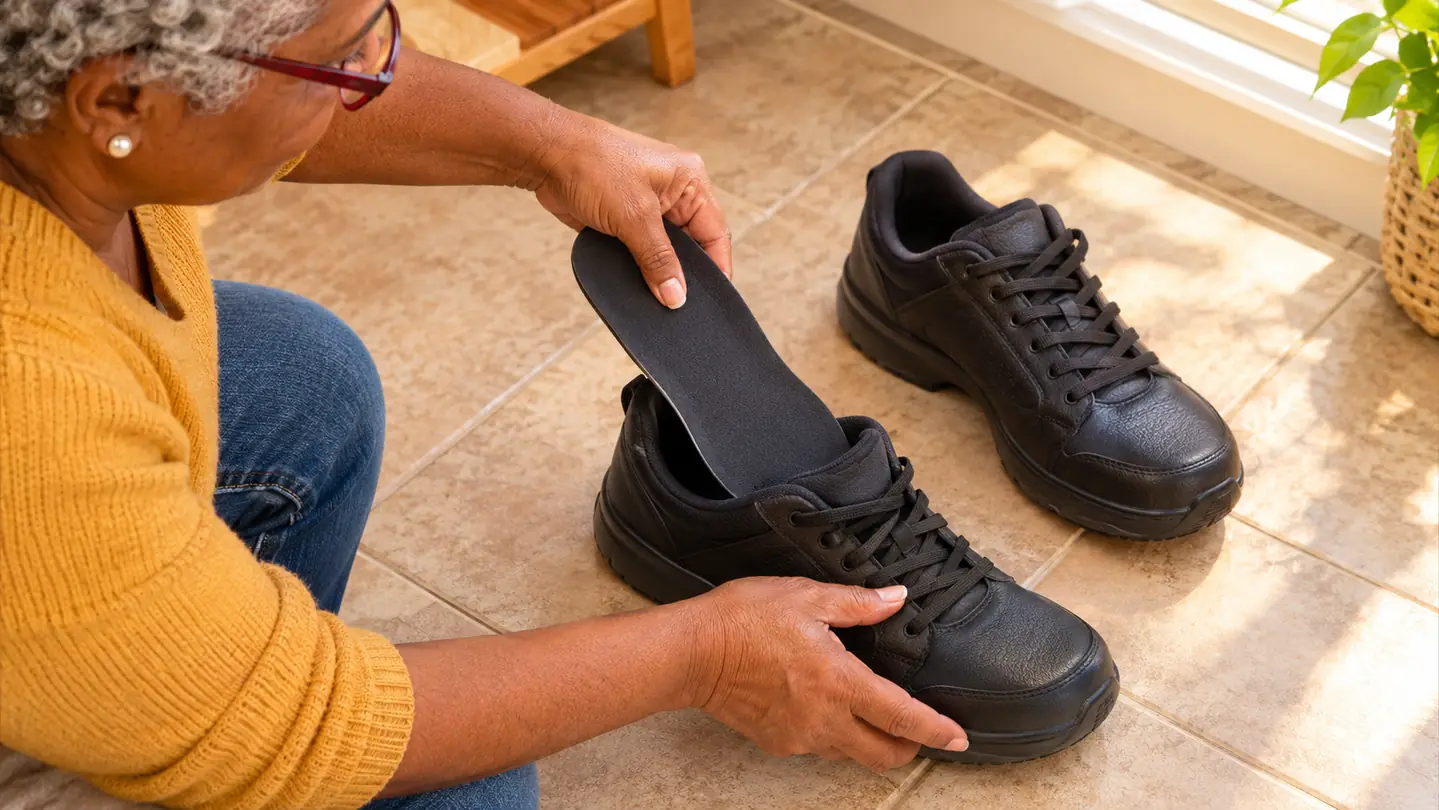
The listing calls it an orthotic insole with a high arch and arch support, and that matches what came out of the box. It is firm. When you press your thumb into the arch section it does not give much, and that is deliberate. The special features listed are anti-slip, anti-odor, heel lift, heel protector, and thin. The two I can speak to directly are the anti-slip and the thin. In ten months I have not once had to fish it out and reposition it inside the shoe, which was a twice a day job with the gel pair. And thin matters more than it sounds: my work sneakers are not roomy, and a thick insert would have made them unwearable.
The material is listed as a recycled polyester and ethylene vinyl acetate blend, and the whole thing weighs about two hundred grams, roughly the weight of a candy bar. Practically, that means it does not turn the shoe into something heavier. The top surface has a slight texture to it. The heel area is built up a little, which is what the heel lift and heel protector language refers to. There is nothing to adjust and nothing to switch on. It is a shaped piece of foam and fabric, and it either suits your foot or it does not.
The sizing on the listing is given as a single measurement band rather than a full spread of sizes, an eleven and a quarter inch length, and it is a trim to fit product. Mine came longer than the liner in my sneakers, which is the point of a trim to fit design, so I cut it down along the guide on the bottom before the first shift. Out of the box it held its own shape. It did not flop over when I picked it up by one end the way the gel pair had, and when I set it on the counter beside the old liner the difference in the arch was obvious at a glance. The old liner was a flat sheet. This one has a hill in it.
The First Three Weeks
The first week was not good. I want to be honest about that, because the reviews that skip it are not useful to anybody. A high arch under a foot that has been sitting in a flat foam liner for two years is a real change, and my arch let me know about it. It was not pain exactly. It was the feeling of a hand pressing up under the middle of my foot, all day, and by four in the afternoon I was aware of it in a way I had never been aware of the old liner at all.
I nearly took it out on the Thursday. What stopped me was that the heel itself, the part that had been the actual problem since October, felt no worse. So I left it in. Somewhere around the sixth or seventh day that pressing feeling became background, and by the end of the second week I was not thinking about the arch at all. By the third week the end of a shift was easier than the middle of one had been in December. Not dramatically. Easier.
Ten Months On
The pair I bought in January is the pair in my sneakers now, in November. The top fabric has gone a little smooth where my heel sits and along the ball of the foot, which you would expect after ten months of eight hour days. The arch has not flattened in any way I can detect by pressing on it. It has not cracked, curled at the edges, or started to smell, and it has not shifted forward in the shoe. About once a month I pull it out, wipe both sides with a damp cloth, and leave it on the windowsill for an hour while I eat my lunch. That is the whole of the maintenance. There is no cover to replace and no part of it that is wearing out ahead of the rest.
The one bad day I have had all year was the store's annual inventory, the last Saturday in June, an eleven hour day that started at six in the morning. My heel flared for about three days afterward and then settled back to where it had been. I am not going to blame the insole for that and I am not going to credit it for the recovery either. Eleven hours on concrete is eleven hours on concrete. What I can say is that the flare was three days and not three weeks, and that in October of 2025 a normal eight hour day was doing the same thing to me.
What I Liked
- Firm arch support that has not flattened after ten months of daily wear
- Thin enough that my work sneakers still fit the way they always did
- Has not slid or bunched inside the shoe once
- A guide on the underside means one pair can be trimmed to sit properly
- The last two hours of an eight hour shift on concrete got easier by week three
Where It Falls Short
- The first week is genuinely uncomfortable while your arch adjusts to it
- It is firm, not soft, so it will not turn a hard floor into a cushioned one
- Trimming is one way. Cut it short and it stays short
- One pair only, so using it in two shoes means moving it twice a day
- The top fabric shows wear at the heel after ten months of daily use
The arch felt wrong for six days. By the third week I had stopped noticing the insole and started noticing that the last hour of a shift was no longer a countdown.

What I Compared It To
Before PCSsole I had two things under my feet. The first was whatever flat foam liner came with the work sneakers, which had been compressed flat by two years of my weight and offered about as much support as a paper towel. The second was a pair of drugstore gel insoles I bought in December 2025. Those felt wonderful for the first hour of the first day. They were soft, and soft is what you think you want when your heel hurts. By the end of a shift they had squashed out to nothing under the heel, and by the third week I was folding them back into place twice a day and getting nothing out of them. I threw them out.
What I remember most is that the gel pair had no shape to speak of. You could fold one in half and it stayed folded. By the end of a shift the heel section had spread out under my weight until it was thinner than the liner it was meant to improve on, and the arch section, such as it was, had gone flat. That is not a knock on gel as a material. It is a knock on a quarter inch of gel trying to hold up a grown adult for eight hours on concrete. Soft and supportive are two different jobs, and that pair only did the first one.
The difference is not softness. The gel pair was softer and worse. The difference is that the PCSsole holds a shape under the arch and at the heel and keeps holding it, so my foot rests on that shape instead of resting on the floor through a quarter inch of foam. If you have tried the drugstore route and found it wanting, that is the specific thing that was missing, and it is worth knowing before you spend again.
I have not tried a custom orthotic and I am not going to pretend I have. Those are molded from your own foot and they cost a great deal more. This is a shaped insole in a single measurement band that you trim yourself at the kitchen table. It is a different category of thing, and I would not want anyone to read this and think the two are equivalent.
Who This Is For
This is for the person who stands or walks on a hard floor for a living and has a heel that complains on the first steps out of bed. That is the shape of my own case and it is the shape most of the reviews on the listing describe. It is also for someone who has already tried the soft gel route and worked out that soft is not the same as supportive. It suits a work shoe that is not roomy, because it is thin. It suits a foot that wants the arch held up rather than padded. If you are on concrete four or five days a week and you want a firmer platform under the middle of your foot, this is a reasonable place to start.
It also suits anyone willing to give it two weeks. The first week is the price of entry. If you are the type to pull an insole out after two days because it feels strange, then this one will not get a fair trial, and you should know that going in rather than find it out on a Thursday afternoon.
Who Should Skip It
Skip it if you want cushioning. There are soft insoles and there are supportive insoles, and this is firmly in the second group. If what you want is the feeling of walking on a mat, this will disappoint you, and the first week will feel like a mistake you paid for.
Skip it if your foot trouble is not a heel and an arch. I am not qualified to say what is going on with anyone else's feet and I am not going to try. If you have numbness, swelling, a sudden injury, or pain that will not settle, that is a conversation with a doctor or a podiatrist and not a purchase. Mine was named by my own doctor in December 2025 and I have followed her advice since, which is the only reason I felt comfortable experimenting with an insole at all. Feet differ, and what worked under mine will not automatically work under yours.
And skip it if you are not going to trim it properly. The guide is on the bottom and it is meant to be followed. Cut it short and it will move around in the shoe, and you will blame the product for a mistake you made with a pair of scissors.
Ten months in, and it is still in my sneakers
If your morning starts with a heel that will not take your weight, this is what I would hand a friend across the counter. Today's price is on the listing.
Amazon Check Today's Price on Amazon →