The first thing I want to say about a foot roller is that it is not the thing that helped my heel the most. I want that on the record before anything else, because you will find plenty of pages telling you a roller will change your life and I am not going to be one of them.
My left heel started hurting in October 2025. Only the left. The right one has never given me a day of trouble. My family doctor, Dr. Okafor, named it plantar fasciitis at one visit in December 2025 and told me to stretch my calves and get better support under my feet. That was the whole of the advice, and it was good advice. Most mornings now the first steps out of bed are a mild ache instead of the stab they were a year ago. Better, not gone.
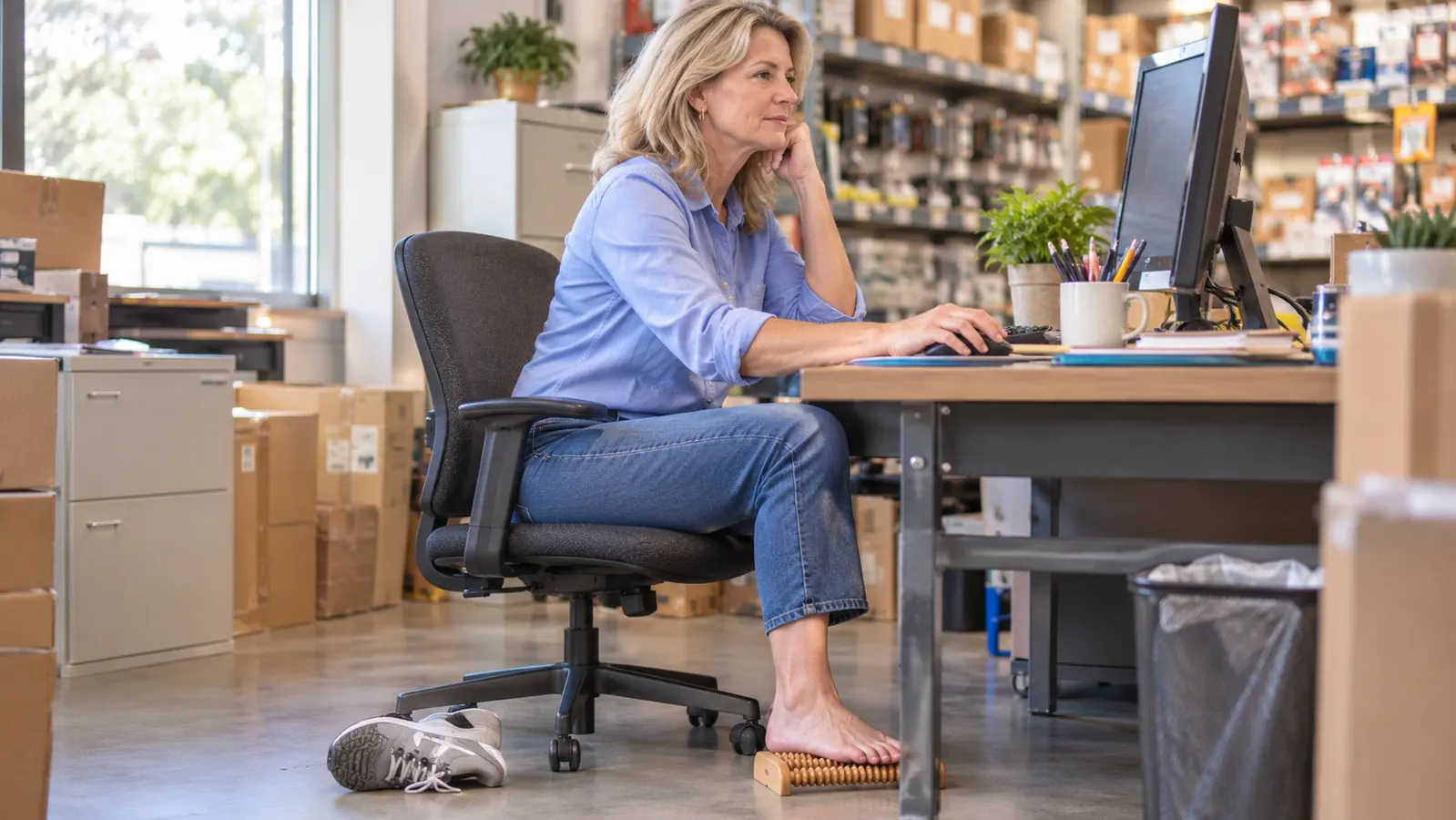
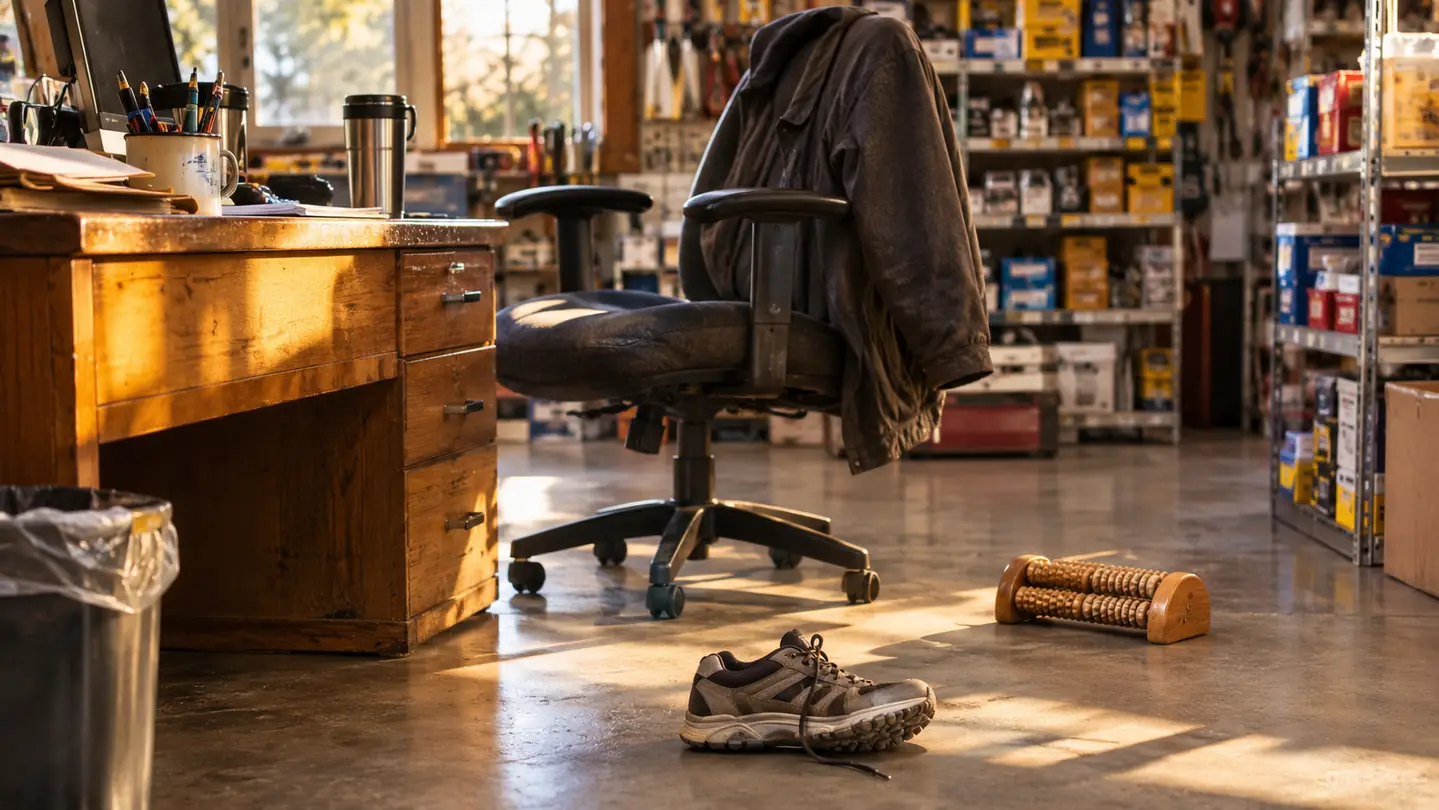
I bought the TheraFlow foot roller in March 2026, eight months ago, and it has lived under the back office desk at the hardware store ever since. It does not come home with me. It does not go in a bag. It sits on the floor by the leg of the desk, and at lunch I take my shoes off and roll my foot on it for about five minutes, and then I put my shoes back on and go back out onto the concrete floor. That is the entire practice.
The one that lives under my desk, not in a drawer
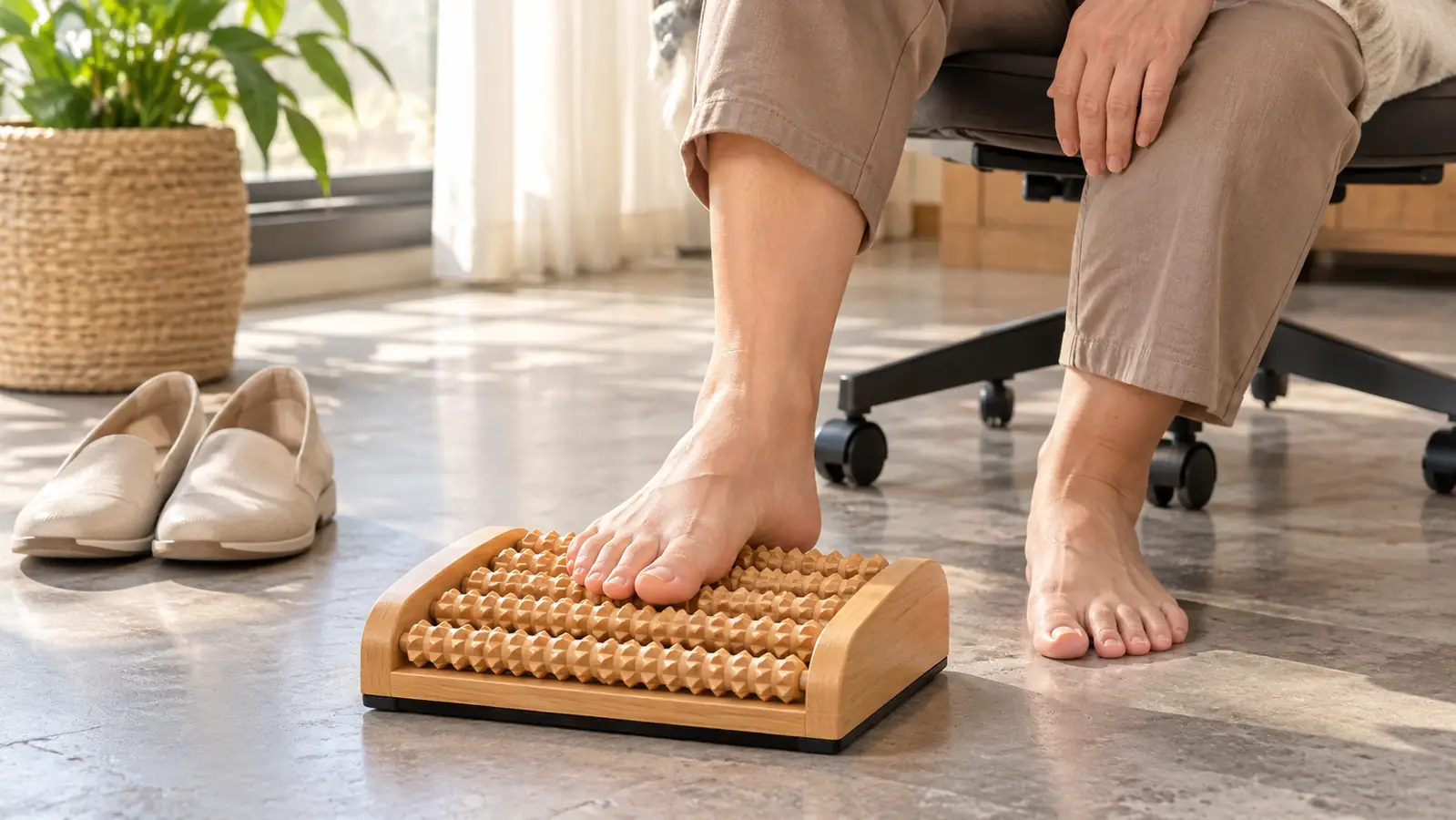
Manual, no cord, no batteries. Five rows across it, four ridged and one set with small nubs, and it runs a little over eleven inches long. Mine has been on the floor of a back office since March and I have not had to think about it once.
Amazon Check Today's Price on Amazon →What a Foot Roller Actually Does
I want to be careful here, because this is where a lot of writing about foot rollers goes somewhere I am not willing to follow. It is not a treatment. It is not a stretch. It does not go inside your shoe and it does not do anything for you while you are standing on a concrete floor for eight hours.
What it does is give you five minutes where the bottom of your foot is being pressed on in a way that feels good, while you are sitting down. That is the honest description. For me that lands in the middle of a shift, which is the part of the day when my foot has been complaining for three hours and there is still three hours to go. Five minutes on the roller and the rest of the shift is a different shift. I have never claimed more than that for it and I am not going to start now.
If you are looking for the thing that changes your mornings, look at what is inside your shoes and what you do before you put them on. The roller is a small comfort in the middle of the day. Small comforts are worth having, as long as you know that is what you are buying.
Step 1: Find the five minutes you already have
Do not build a routine around a foot roller. Build it around a gap you already sit still for. That sounds like a small distinction but it is the difference between a roller you use and a roller that ends up in the closet with the resistance bands somebody gave you.
My gap is lunch. I work at a family hardware store in Medford, Oregon, Tuesday through Friday, 8 to 5, and I have been there fourteen years. Most of it is on my feet on a concrete floor, with a small desk in the back office where I eat. Somewhere in the middle of that lunch, I take my shoe off and spend five minutes with the roller. Nobody needs me for those five minutes. That is why it works.
At home I already had the morning stretch and the sandals parked beside the bed. The middle of a shift was the one part of the day that had nothing in it. That is where the roller went. If you are on your feet all day, look for the break you already take, whether that is a lunch, a coffee at ten, or the ten minutes after everyone else has gone home. If you sit at a desk all day, this is easier. Put it under the desk and forget it is there until you want it.
Step 2: Take the shoe and the sock off the foot that hurts
For me this is the left foot. That is the one that started in October 2025 and the one that still reminds me on the first steps out of bed. I roll the left one for the full five minutes and give the right one a minute at the end, mostly so it does not feel left out of the proceedings.
Shoe off, sock off, both feet flat on the floor to begin with. You want a chair low enough that your thigh sits roughly level and your foot can rest flat without you holding it up. Not a stool so high that your foot dangles. My desk chair is nothing special, but it is the right height and I am already sitting in it, which is most of the battle.
If your feet are swollen, if the skin is broken, or if there is a bruise you cannot account for, leave the roller alone that day and get it looked at. I am an office manager in Medford, not a clinician, and that is not something I can sort out for you from here.
Step 3: Start at the arch and go slowly
The TheraFlow roller has five rows across it. Four of them are ridged and one row is made of small rounded nubs. Start on the ridged rows under the arch, not on the nubs, and not on the heel. Roll slowly enough that you could count the ridges going past if you wanted to. Fast rolling on a wooden roller is just rubbing, and rubbing hard is how people end up sore in a brand new place.
Pressure is the part most people get wrong. Rest your foot on the roller and roll it. Do not stand up on it. If you feel yourself flinching, put less weight down. There is no prize for bearing down, and the foot does not keep score of how tough you were. The first few times, my arch could only take a light roll for a minute before it wanted me to stop, and that was fine. It built up over a couple of weeks without me doing anything clever about it.
The nub row is the one I use last and least. Some people love it and I can see why. I find it better on the ball of the foot than on the arch, and it is the row I would miss the least if it were not there. Try it once and decide for yourself.
Step 4: Work back to the heel, then forward to the ball of the foot
After the arch, work the roller back to the heel. This is the part I care about, because the heel is where mine started. Roll the heel slowly over the ridged rows a few times and let it settle into the spot that complains. It is a strange feeling, not exactly pleasant, and then it is over and the heel feels less tight than it did.
Then forward to the ball of the foot and the toes. Same slow roll, lighter pressure again, because that area is more tender than it looks. After that I turn the roller sideways and roll the outer edge of the foot. I started doing that by accident one day when the roller had rolled out of position, and now it is part of the five minutes.
Here is my honest report from eight months of this, and it has not changed. Five minutes on the roller feels good for an hour or so. My foot feels looser when I stand back up. I do not claim anything past that, and I would be skeptical of anyone who does. The things that changed my mornings were the insoles and the morning stretch. The roller was never going to be one of those and it has never pretended to be.
Step 5: Stop at five minutes and put your shoes back on
Five minutes. Not fifteen. This is the one instruction I would underline twice. It feels good while you are doing it, which makes it very easy to keep going, and the foot does not get more out of a longer session. Twenty minutes with the roller is not four times better than five. It is just twenty minutes of your lunch, gone.
When you stop, put the shoe back on. The concrete floor at work is not a place to walk around in socks, and the insoles inside my sneakers are doing the job they do all shift. The roller does not replace them and it does not go inside anything. Nothing about it is meant to be worn.
Stand up slowly the first few times. The foot will feel different and slightly unfamiliar, and walking fast on a foot that feels unfamiliar is a good way to turn an ankle. After eight months I stand up without thinking about it. I did not the first week.
I am not going to tell you it fixed anything. I am going to tell you that eight months on I still do it, and I would notice if I stopped.
What Else Helps
The roller is one of five things I bought between January and May, one at a time, and it does the smallest job of the five. I want to be plain about that, because a page about a foot roller is not the place to pretend a foot roller is the whole answer.
The insoles go inside the work sneakers and nowhere else. I bought the first pair in January 2026 and trimmed them along the cutting line. The arch felt odd for the first week, like standing on a ridge that was in the wrong place. By week three, the end of a shift felt easier. Those did more for my mornings than the roller ever did, and I would buy them again before I bought anything else on this list.
The calf stretcher is a rubber rocker that lives on the bathroom tile beside the counter. I use it every morning before shoes, three holds of thirty seconds per leg, with one hand on the counter for balance. My calves felt looser after about four weeks of that. Before February I had been doing a wall stretch, and I still do it some evenings, but the rocker is what actually happens every morning because it is sitting right there.
The compression socks go under the work sneakers every shift and never to bed. The snug feel took about a week to get used to. The sandals are parked beside my bed and worn at home and to the mailbox, and nowhere else. And before the roller I spent about two weeks in February with a tennis ball under the desk, which is the thing people suggest when they do not want to suggest buying anything. It worked well enough that I understood the appeal. It also rolled away every time I got up, and it was never where I left it, and that is the honest reason I replaced it.
Every one of those has its own slot. The insoles are inside the shoe. The socks are under the shoe. The stretcher is at home in the morning. The sandals are at home in the evening. The TheraFlow roller is at work at lunch with my shoes off. None of them is doing another one's job, and I think that is why I have kept all five going for the better part of a year. If the roller broke tomorrow I would replace it first, not because it is the best of them but because it is the only one of the five I can use at work at all.
When Not to Roll It
Numbness is the one I would take seriously. If part of your foot goes numb, or if it is swollen, or if the soreness started after a sudden twist or a fall, the roller is not the thing to reach for. Go see your doctor or a podiatrist. That is not caution for the sake of it. Numbness and swelling are questions a roller cannot answer.
The same goes for pain that will not settle. Mine has gotten better over a year without ever getting gone, and Dr. Okafor is the one who named it and the one I would ask if it changed shape on me. I am not a doctor and I am not going to write about this as though I were. Feet differ. What happened in my left heel is not a forecast for yours, and five minutes with a roller is a comfort, not a plan.
It sits under my desk. That is the whole of it.
Five rows, four ridged and one set with small nubs, on a manual roller a little over eleven inches long that weighs under two pounds. No cord, no batteries, nothing to charge and nothing to lose. Mine has been on the floor of a hardware store back office since March and it still looks like it did the day it arrived.
Amazon Check Today's Price on Amazon →