
I am 59, I run the front office and the floor at a family hardware store in Medford, Oregon, and I spend most of my shift on concrete. My left heel started hurting in October 2025. The right foot has never given me a day of trouble. The worst part was the first four or five steps out of bed, and the first few steps after I stood up from my desk. My family doctor, Dr. Okafor, named it plantar fasciitis in December 2025, told me to stretch my calves, and told me to get better support under my feet. That was the whole plan. No podiatrist, no imaging, no night splint.
I bought SB SOX compression socks in April 2026, seven months ago, two pairs at once. I had already tried drugstore gel insoles for three weeks in December 2025, and I had a pair of PCSsole insoles in my work sneakers since the first week of January 2026. The socks came after the insoles and after the calf stretcher. I wanted something that would help me get through a Tuesday to Friday on a concrete floor without thinking about my heel every time I shifted my weight. The listing calls them compression socks for plantar fasciitis relief. I cannot tell you they treat anything. I can tell you what I noticed in my own feet, and I can tell you who I think they are wrong for.
The Quick Verdict
A snug ankle compression sock that made my long shifts on concrete feel less punishing, once I stopped guessing my size and measured my arch. The fit chart is the part that matters.
Amazon Check Today's Price →Measure your arch before you order, then let the sock do its quiet work
I bought two pairs of SB SOX in April 2026 and wore them under my work sneakers every shift. If your heel is the first thing you think about in the morning, start with the size chart, not the reviews.
Amazon Check Today's Price on Amazon →How I've Used It
I wear them under the same plain lace-up work sneakers I have worn since 2024. I put them on before I leave the bedroom, and I take them off when I get home. I do not sleep in them. I do not wear them on the Sunday walk with Don, because that walk is 1.5 paved miles and I want my regular cotton crew socks for it. The socks are for the shift, and that is it.
I bought them in April 2026 on a Wednesday, the week after a stretch of shifts where I had started jotting a note on the back of a receipt in my apron pocket every time I noticed my heel. It was a silly thing to do, but it gave me a baseline. The first shift in the socks was a Thursday, a normal 8 to 5 split between the counter and the aisles. I remember two things about it. The sock felt snug when I pulled it on, and by mid morning I had stopped thinking about the sock. I still noticed my heel. I just did not notice the sock.
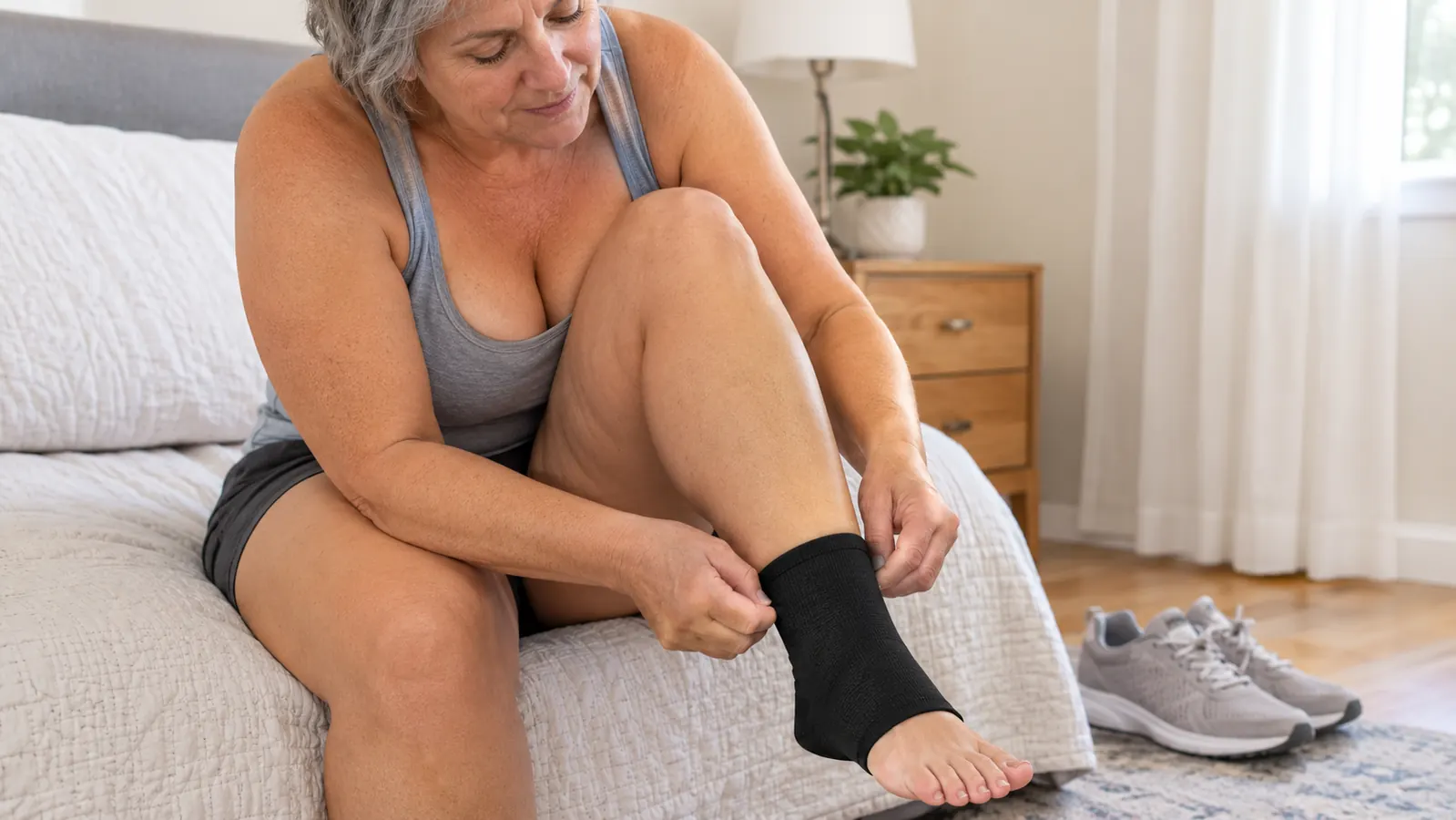
The first week was an adjustment. The sock is snug around the arch and the ankle, and I was aware of it for the first hour or two. By the end of the first week I stopped noticing it. That is the honest timeline. If you put it on and expect a wave of comfort, you will be disappointed. It is a firm hug, not a pillow.
I machine wash them and let them air dry. I have two pairs, so one is clean while the other is on my feet. Seven months in, they have kept their shape enough that I still wear them the same way. I have not had a seam let go or a cuff roll down into my shoe.
What the Sock Actually Does on a Long Shift
On a normal Tuesday, I am on my feet from 8 to 5, with a small desk in the back office and a lunch break. The floor is concrete. Before the socks, the heel would announce itself around 2 pm, especially after I had been standing at the counter for a long run of customers. With the socks, I noticed the ache later in the day, and it was duller. That is the whole of my claim. I did not float through the afternoon. I just stopped checking the clock and calculating how many hours were left.
There was a stretch in July 2026 when the store was short handed and I spent more of the day at the counter than at my desk. Those were the days the socks earned their place. Standing in one spot for forty minutes at a time, ringing up deck screws and answering the same question about paint matching, my heel would start to ache in a low, steady way. With the socks on, that ache arrived later in the afternoon and stayed quieter. I want to be careful here. This was not a dramatic difference. It was the difference between noticing my heel at one o'clock and noticing it at three, and the difference between an ache that made me short with people and an ache I could set aside while I helped the next customer.
The compression is targeted. The listing describes it as targeted compression that works with your foot. I am not going to dress that up in medical language. What I felt was steady pressure around the arch and ankle, the kind that makes a shoe feel more deliberate. It did not feel like a tight band digging into my ankle. If it had, I would have taken it off.
I also wore them on inventory Saturday in late June 2026, which was an 11 hour day. That was the one bad day I have had since I started this routine. My heel flared for about three days after. The socks did not prevent that. I do not think any sock could have. But I was glad to have them on during the day, and I went back to my normal routine after.
The Fit Question: Arch Measurement, Not Shoe Size
The most useful thing I can tell you is to measure your arch, not your shoe size. The SB SOX listing gives arch ranges: Small for a 5 to 8 inch arch, Medium for 7 to 10 inches, Large for 9 to 13 inches, and X-Large for 12 to 15 inches. Those ranges overlap on purpose, I think, because feet are not uniform. I measured mine with a cloth tape while sitting on the bathroom tile, wrote the number down, and picked from that chart. I am not going to tell you my size because your foot is not my foot.
I will tell you how I got the measurement wrong the first time, because it may save you the same trouble. I measured standing up, with the tape pulled tight, and I got a number at the bottom of one size. Then I read the chart again and realized I had measured the length of my whole foot, not my arch. Those are not the same measurement. I sat down on the bathroom tile and measured again, from the back of the heel to the ball of the foot where the arch ends, and got a different number. That second number is the one the chart wants. A cloth tape is better than a metal one, and take it slowly.
The sock is a pull-on ankle compression sock. It is nylon and spandex, according to the listing, and it is lightweight. That matters on a concrete floor in July. A heavy sock would have made my sneakers feel like boots. This one did not add heat I noticed. The package is small, 8.66 by 4.96 by 0.67 inches, and the pair weighs about 2.12 ounces. I know that sounds like a shipping detail, but it tells you the sock is thin. It is.
I bought two pairs. That was the right call for me. One pair would have meant washing it every night, and I am not reliable about that after a shift. Two pairs let me rotate. If you are going to try them, I would get two, not five. Give the first pair a week before you decide.
Where They Helped and Where They Didn't
They helped most on the days I was standing at the counter, not the days I was walking. When I was moving, my heel was already warmed up. When I was standing still, the pressure would build. The sock gave me a sense of support in that still standing, which is hard to describe without sounding like a commercial. I will say it this way: I stopped shifting my weight from one foot to the other as often.
They did not help the first steps out of bed. That is not what they are for in my routine. The first steps are the sandals beside my bed, the recovery slides I bought in May 2026. I put those on before my feet hit the tile. The socks are in the bedroom, but I do not put them on in the middle of the night. I put them on when I am getting dressed for work. If you are looking for something to wear to bed, this is not that product, and I would not wear them to bed.
They also did not replace the insoles. My PCSsole insoles are in the work sneakers every shift. The socks go under the sneakers, over my foot. The insoles are the firm arch under the foot, the socks are the snug layer around it. I would not choose one over the other. I would say the socks are the easier thing to try first if you are not ready to trim an insole, and the insoles are the thing that changed how the end of a shift felt for me. I bought both. I still use both.
Living With Them: Washing, Wear, and the Seven-Month View
Seven months is long enough to know if a sock is going to annoy me. These do not. The cuff stays put. The fabric has not pilled badly. I wash them with my regular laundry, machine wash, and I air dry them on a rack in the bathroom. I have not put them in the dryer. That is not a rule from the listing, it is just what I do with anything with spandex.
The fabric has held up better than I expected for something this thin. The listing says nylon and spandex. After seven months of weekly washing and air drying on a rack in the bathroom, the band at the top has not gone slack. The arch section has not stretched into a loose ring. I have one pair I reach for first, so it has been washed more often than the other, and even that pair still fits the way it did in May. If they had gone loose by August I would have said so in plain terms. They have not.
I am not going to do the math for you. I bought them once and I have not had to replace them. If you are comparing them to a drugstore sock, they are a different thing. A cotton crew sock is not compression. I still wear cotton crew socks on my days off and on the Sunday walk. The SB SOX socks are for the shift. If you want one sock for everything, you will be disappointed.
I am not a runner. I am not a hiker. I am a 59 year old woman who works on concrete and wants to keep walking the 1.5 mile loop with her husband on Sundays. The socks fit that life. They are not a training tool for me. They are a work supply, like my knee pad for kneeling at the bottom shelf. That is the most honest framing I can give you.
The sock did not make my heel new. It made a Tuesday on concrete feel less like a countdown to 5 o'clock.
What I Liked
- Snug, targeted pressure around the arch and ankle that I noticed most during long standing stretches.
- Thin enough to wear under my work sneakers without making them feel tight.
- Stayed put through a seven month rotation, two pairs, machine washed and air dried.
- Arch based sizing gave me a clearer starting point than shoe size.
Where It Falls Short
- The first week feels snug, not soft. It is an adjustment.
- You need to measure your arch. Guessing will get you the wrong size.
- They did not stop the first steps out of bed from hurting. That is a different job.
- Two pairs means two purchases, and one pair means washing every night.
Who This Is For
If you stand or walk on a hard floor for a living, if your heel is the first thing you think about in the morning, and if you have already been told to get better support, these are worth a look. They are also for the person who wants a low profile layer under their regular work shoes, not a new shoe. I would start with the arch chart and two pairs. I would give them a week. I would not expect them to do the job of an insole, a stretcher, or a sandal by the bed. They are one piece of a routine.
Who Should Skip It
Skip them if you want a sock to wear to bed. Skip them if you have numbness, swelling, a sudden injury, or pain that will not settle. That is a doctor or podiatrist conversation, not a sock conversation. Skip them if you will not measure your arch and you plan to guess. Skip them if you are looking for a loose, cushioned house sock. This is a compression sock, and it feels like one. And skip them if you expect a single product to be the whole answer. My heel is better than it was in October 2025, not gone. I credit the routine, not one item, and I would tell you the same at my kitchen table.
If the fit chart makes sense for your foot, the sock is a low risk place to start
I bought two pairs of SB SOX in April 2026. Seven months later they are still in the rotation under my work sneakers. Measure your arch, give it a week, and keep your other supports in place.
Amazon Check Today's Price on Amazon →