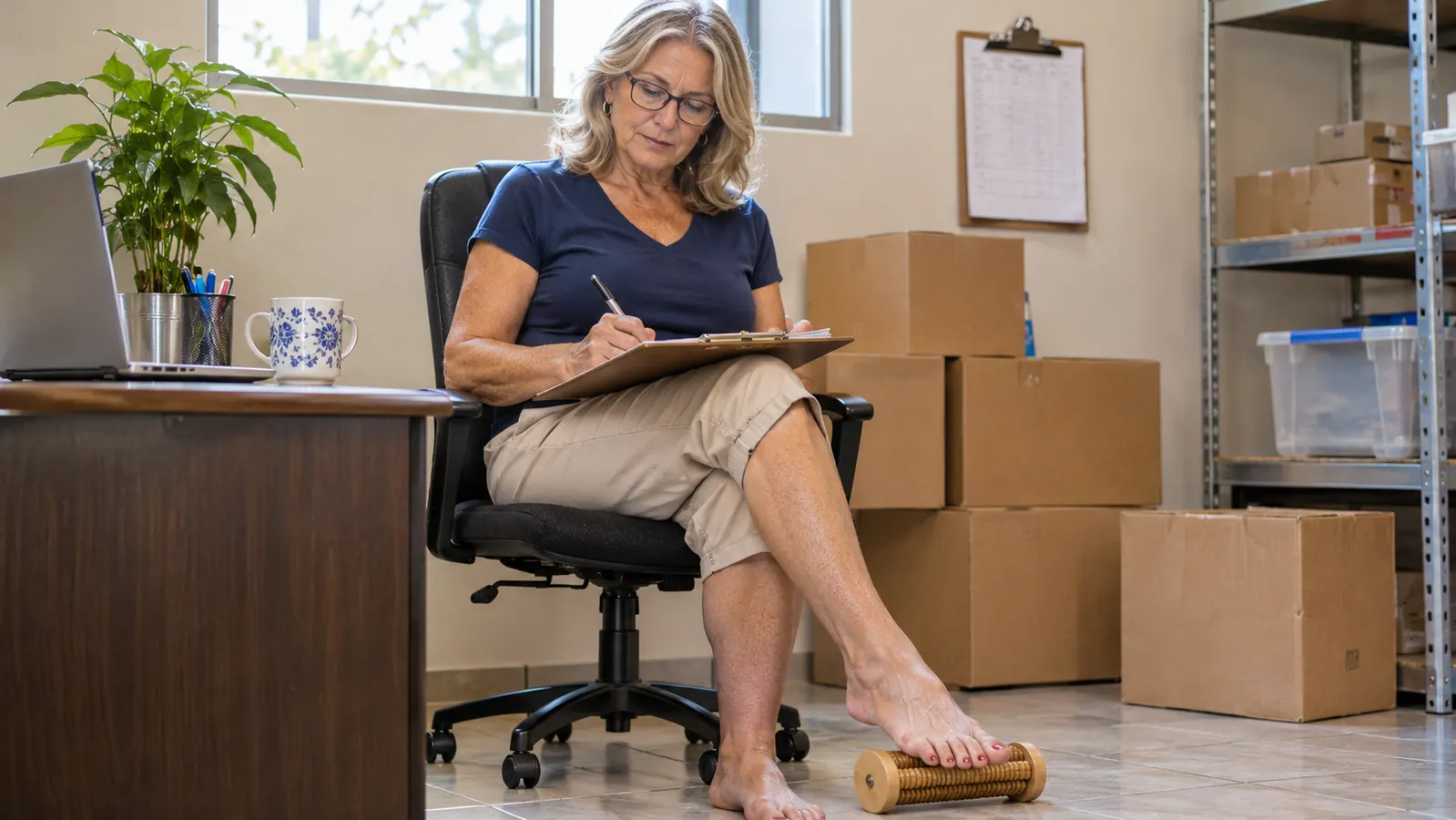
This is the part most reviews skip. TheraFlow sells a piece of wood with five rows of bumps on it, and it does one small thing well. It does not do several larger things people hope it will. I bought mine in March 2026 with my own money, eight months ago now, and I have used it in exactly one place since. It lives under the small desk in the back office at the hardware store where I work. I use it at lunch, shoes off, about five minutes, four days a week. Whether it belongs under your desk too depends far less on the roller than on what you expect it to change.
I am 59. My left heel has hurt since October 2025, worst on the first steps out of bed and again after I have been sitting for a while. My family doctor named it plantar fasciitis in December 2025 and told me to stretch my calves and get better support. She did not tell me to buy a roller. Nobody did. I bought it because a tennis ball under the desk for two weeks in February had become a nuisance. The ball kept rolling off toward the filing cabinet and I kept fishing it out with a broom handle. I wanted something that stayed where I put it. That was the entire reasoning, and I am not going to dress it up as a careful purchase.
The Quick Verdict
Worth it for a five minute lunch habit you will actually keep. Not worth it if you are expecting the heel to change.
Amazon Check Today's Price →Five minutes at lunch, four days a week, eight months and counting
Wood, five rows, manual. Nothing to charge, nothing to plug in, nothing to learn. If that sounds like a habit you would keep at your desk, here it is.
Amazon Check Today's Price on Amazon →What It Is, Plainly
TheraFlow calls it a wooden foot massager, and that is accurate as far as it goes. It is made from Schima Superba, a hardwood, and it measures 11.2 by 2.5 by 7.5 inches and weighs 1.79 pounds. Five rows run across the top. Four of them are ridged and the fifth is a row of rounded nubs. The listing calls that acupressure and reflexology. What it is, physically, is two different textures under a bare foot. Nothing on it moves, lights up, vibrates or needs charging. The power source is manual, which is the only honest way to describe a block of wood.
That is not a complaint. Something with no cord, no battery and no settings is the reason I still use it eight months on. It sits where I leave it. It has never needed anything from me. I have never spent a lunch break looking for an outlet, and I have never had to wonder whether it was charged.
How I Use It, and How Long That Took to Settle
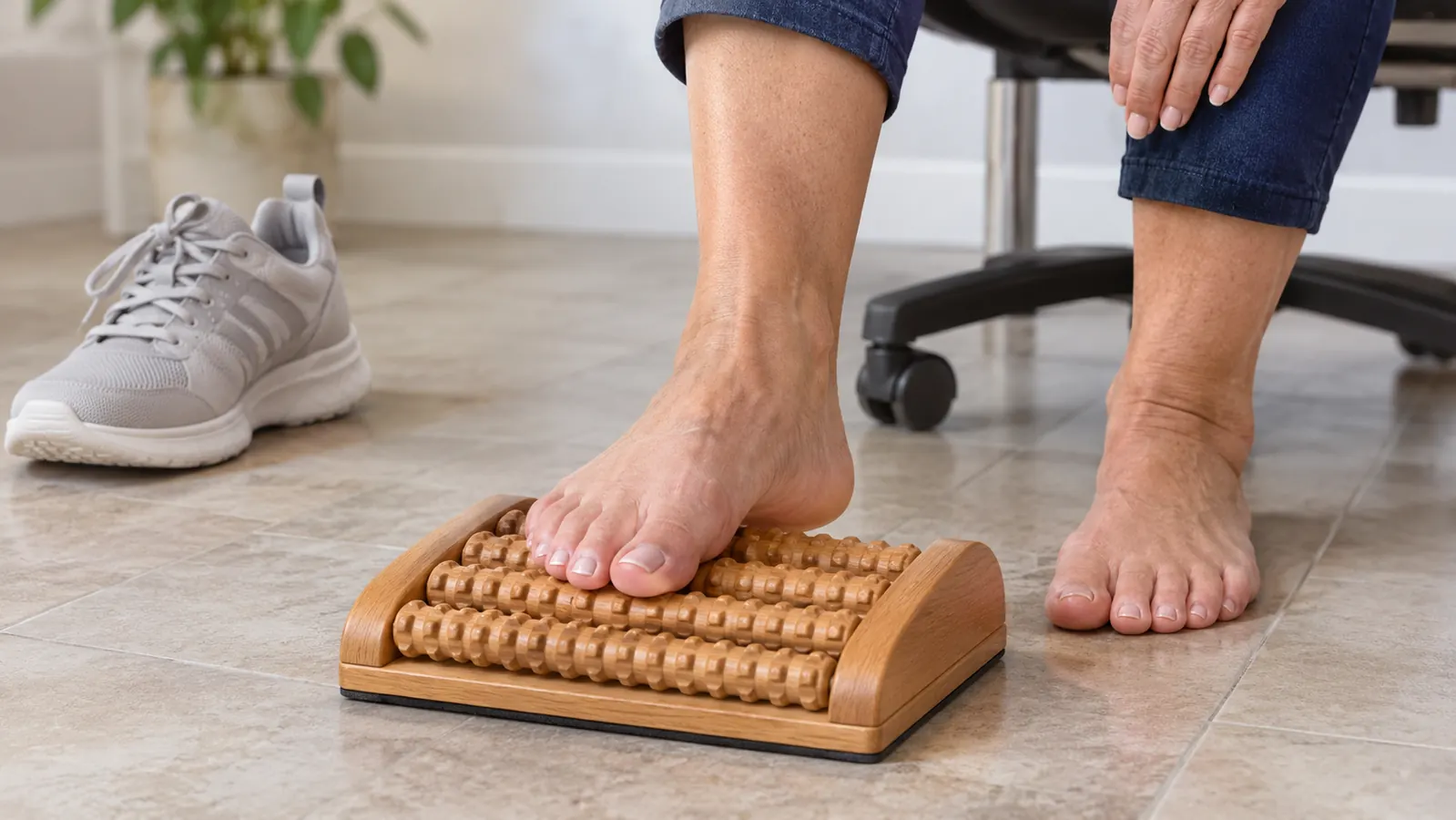
My routine is not interesting. At lunch I shut the office door, take my sneakers off, and put the roller on the tile floor in front of my chair. I start with the left foot, because the left foot is the one that hurts, and I roll from the ball of the foot back toward the heel for about two and a half minutes. Then I switch and do the same on the right, which has never hurt, mostly out of fairness. Then the shoes go back on and I go back out onto the concrete.
The first week was clumsy. I had it too far under the chair and kept catching my heel on the near edge at a bad angle. Moving it six inches forward fixed that. The second thing I got wrong was pressure. I started out leaning my whole weight into it, the way you would work a knot out of a shoulder, and the bottom of my foot felt bruised by two in the afternoon. Lighter pressure and more passes was better. That took about two weeks to work out, and nobody told me, so I am telling you.
I keep my socks on sometimes when the office is cold. It works, but the ridges are less useful through cotton, and it mostly becomes a footrest that happens to be shaped like a roller. Barefoot is the version worth having. I also want to be honest about the frequency. Four days a week is the plan. Some weeks it is three, and there was a stretch in July when I did not touch it for nine days because we were short-staffed and lunch was a sandwich eaten standing up.
The Honest Part: What It Does and What It Does Not
Here is the whole of my claim. It feels good while I am doing it and for about an hour afterward. The bottom of my foot is looser when I stand up from the desk than it would have been if I had spent those five minutes reading email. That is the benefit and I am not going to inflate it. I do not notice it by the time I get home. I do not notice it the next morning. My first steps out of bed are what they are, and a roller under a desk twelve miles away has nothing to do with them.
I want to be plain here, because the title of the listing includes the words plantar fasciitis relief, and it would be easy to read that as a promise about the condition. I cannot tell you it changed mine. What I can tell you is what I noticed in my own two feet across eight months: a pleasant five minutes at lunch, and no lasting shift I can point to and measure. My mornings are milder than they were a year ago. I credit a lot of small things done for a long time, and I cannot pull any single one of them out of the pile, this roller included.
It feels good while I am doing it and for about an hour afterward. That is my entire claim, and eight months has not added to it.
Feet differ, too. Mine are mine. What my left heel does is not a forecast about yours. I have read plenty of reviews of this thing that promised the world, and plenty that called it useless, and both sets of people probably meant it. A hard object under a sore foot is going to land differently on different feet.
Where It Falls Short
The heel is the part that hurts most people, mine included, and it is the part this roller reaches least well. The row of nubs sits back toward one end, and to get the heel onto it you have to angle your foot off the front edge, which is not a stable way to sit in an office chair. Most of the time my heel ends up resting on the flat end of the frame rather than on anything textured. The arch and the ball of the foot get the real work, and they are not where my problem is.
It is also a floor object, and that assumes a few things. It assumes you can get down to it and back up again without trouble. It assumes a floor in a room where taking your shoes off is acceptable. At 59 with a bad heel I am fine on both counts, but I would not want to be doing this off the ground if my knees were worse than they are, and I would not want to be doing it on a shop floor with a customer waiting.
And it is five minutes in the middle of a workday. If your heel is at its worst at six in the morning, the roller cannot help you at six in the morning unless you keep one beside the bed, which is not what I did and not what I would suggest first. A roller under a desk is an at-work item. The morning is a different problem and it wants a different answer.
Eight Months Later, What It Looks Like
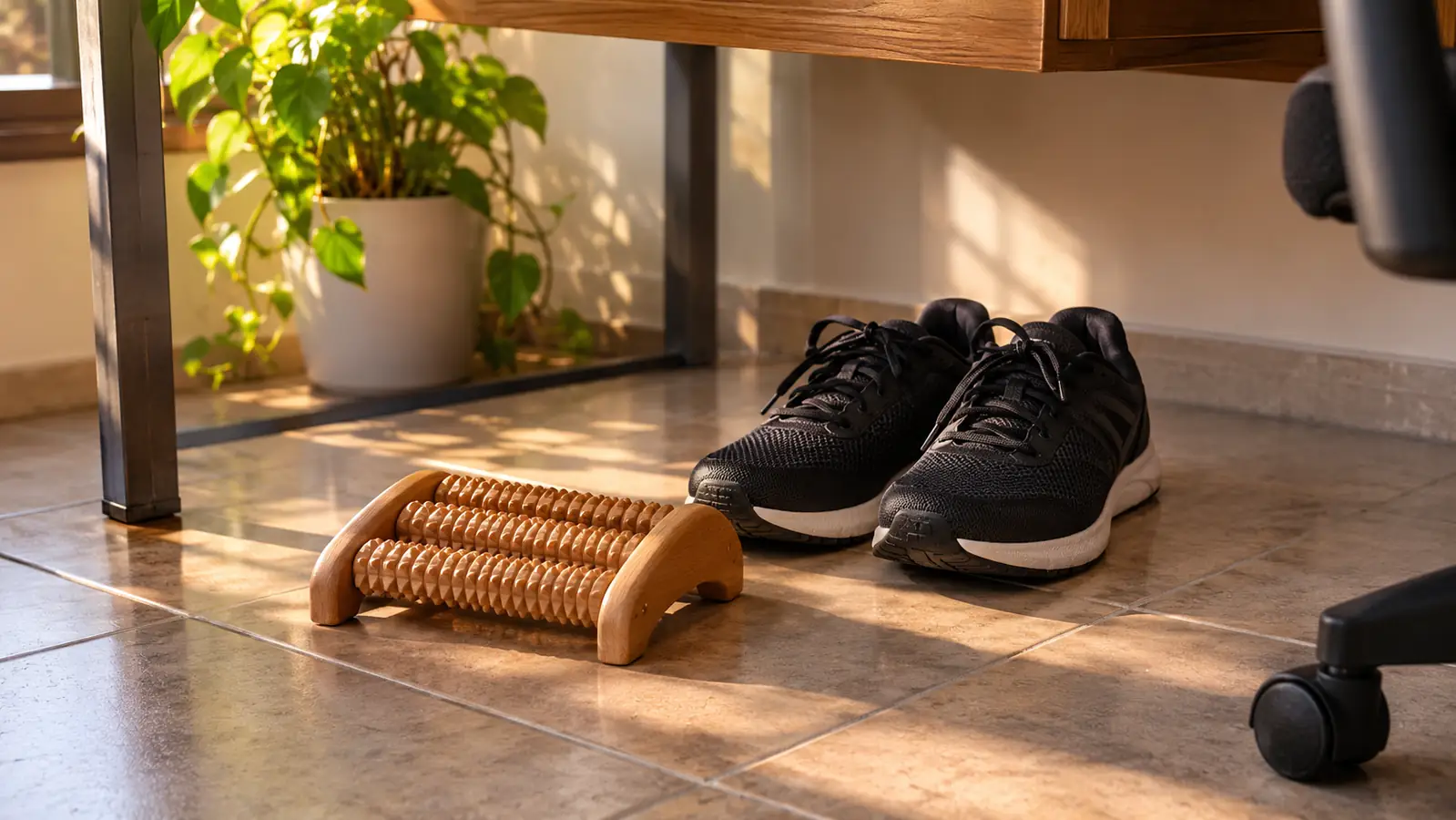
The TheraFlow roller has held up better than anything else I have bought for my feet, which is not surprising given what it is. There is nothing to wear out. The edges are as crisp as they were in March. The wood has not split, chipped or developed a wobble. I wipe it with a disinfecting wipe once a week and that is the whole of the maintenance. It has been knocked onto the tile twice and it did not care.
Two small things. The ridged rows collect lint from socks in the grooves, and you have to pick it out with a fingernail or the corner of a key. And it is heavy enough at 1.79 pounds that you know when you have kicked it, which I have done more than once at the end of a long day in a dim back office.
What I Would Do First, If I Were Starting Over
I would still buy the insoles first. Mine went into the work sneakers in the first week of January 2026, and by the third week the end of a shift felt easier than it had in months. That is the change I would least want to give up. The calf stretcher came in February and the roller came in March. If I had been allowed only one purchase that first month, it would not have been the roller.
Before I close the book on the tennis ball, since it is the thing everybody reaches for first: it is not a bad tool, it is a badly behaved one. It worked under my arch for those two weeks in February and I could feel it doing something. But a ball has no weight and no edges. It skitters across tile the moment you shift, it rolls under the radiator, and you cannot leave it beneath a desk without half the staff kicking it down the hall. The roller solves the behaving problem and gives you ridges instead of a smooth curve. Whether ridges are actually better than a smooth ball is something I could not tell you with a straight face. They are different. I kept the roller.
But the roller is the one I have actually kept up with, and that counts for something. The insoles live inside my shoes, where I do not have to think about them. The stretcher lives on the bathroom floor at home, where it is easy to walk past. The roller is the only one of the three that fits inside a workday without any planning at all. Consistency is not a small thing over eight months. It is just not the same thing as relief.
What I Liked
- Five rows in two textures, and the ridged ones do real work on the arch and the ball of the foot.
- Manual and cordless, so nothing to charge, plug in or break.
- 1.79 pounds and about eleven inches long, so it tucks under a desk without being in the way.
- Eight months of regular use and it still looks like what it is, a solid piece of hardwood.
- No settings to learn. You put your bare foot on it and roll.
Where It Falls Short
- The heel gets the least of it, and the heel is usually the point.
- Barefoot only, really. Through a cotton sock it is mostly a footrest.
- It assumes a floor, a desk and shoes you can take off at work.
- It does nothing for the morning, which is when mine is worst.
- Two weeks of pressing too hard before I worked out that lighter is better.
Who This Is For
You have a desk, or you get to one at lunch, and you can take your shoes off there without it being strange. You already spend money on your feet and you are not expecting one purchase to end the problem. You want something with no battery to die and nothing to charge in the middle of a workday. You are willing to do five minutes a day for a month before deciding whether it did anything. And you are honest with yourself that feeling better for an hour is a real thing even when it is not a lasting thing.
That last one is the whole market as far as I can tell. If a warm, loosened foot at one o'clock in the afternoon would improve your day, this does that, reliably, for as long as you keep it under the desk. It asks nothing of you but the five minutes.
Who Should Skip It
Skip it if your heel is at its worst in the morning and you were hoping this would be the thing you reach for first. It is a floor item in a room with a desk. It will not be beside your bed, and even if you moved it there, five minutes on a cold morning before your first steps is a much harder habit to keep than five minutes at lunch.
Skip it if you cannot comfortably get down to the floor and back up, or if the only place you could use it is deep carpet where the roller disappears. Skip it if a tennis ball for two weeks did nothing for you, because the roller is a better-behaved tennis ball and not a different category of thing. Skip it if you want hardware, if you are picturing something that vibrates or heats or does the work for you. This is a block of wood and it will disappoint you.
And one more, plainly, because it matters more than the purchase. If your foot is numb, or swollen, or the pain arrived suddenly, or it has been going on and will not settle, that is a doctor's conversation and not a shopping one. Mine has been looked at. Yours should be too.
If the five minutes at lunch is the part you want, this is the one I kept
It will not change your mornings. It will make one o'clock better, four days a week, for as long as you leave it under the desk.
Amazon Check Today's Price on Amazon →