
The first steps out of bed tell you the most. Mine stopped me at the edge of the mattress for months, left heel only, right foot fine. That started in October 2025 and it has not fully gone away. What changed is the floor I land on. In May 2026 I bought a pair of KuaiLu recovery sandals and parked them beside the bed, and the kitchen tile stopped being the worst part of my morning.
If you are reading this you have probably already stood in a shoe store or scrolled a listing and felt the fog settle. Every pair claims cushioning. Every pair shows somebody smiling on a beach. None of them tell you whether the thing will still feel right at six in the morning, after seven hours off your feet, when your heel has tightened up and the first step is the one you dread. You cannot test that in a store. So you shop on the things you can check before you pay, and you accept that the rest is a two week experiment.
I tried the free options first, the way most people do. Barefoot on the carpet, which was fine. Barefoot on the kitchen tile, which was not. A pair of flat rubber flip flops for the porch and the mailbox, which were easy to slide on and did nothing for the ten steps to the bathroom. That is the trap. The cheap thing is not wrong, it is answering a different question than the one your heel is asking.
The pair I step into before my feet have decided anything
KuaiLu recovery sandals: a slip on slide with a single strap, arch support and a shock absorbing footbed. What they did for me was make the first ten minutes of the day softer. That is the whole of the claim.
Amazon Check Today's Price on Amazon →Step 1: Write down when it hurts before you look at a single sandal
Spend two days noticing instead of shopping. Not the whole day. Just the moments when your foot announces itself. For me there were three: the first four or five steps out of bed, the first steps after sitting through a lunch break, and the walk from the back office to the front counter on the concrete. I wrote them on the back of a receipt, because by the time I got home I had forgotten half of it.
The pattern matters more than the intensity. If your heel is worst first thing and eases once you move, you have a morning problem, and the tool you need lives beside your bed. If it builds through the day and shouts at five o'clock, the surface you stand on is the issue and the answer is more likely inside your work shoes. Most people I know have a bit of both, with one louder than the other.
Write down the surfaces too. My house is a single story ranch with tile in the kitchen and the bathroom, hardwood in the hall and carpet in the bedroom. The tile was the one that hurt. Ten steps from the bed to the bathroom on a cold hard floor is a different experience than ten steps on carpet, and a sandal beside the bed only helps if it handles the floor you actually cross.
Two days of notes is plenty. You are not building a case file. You are trying to avoid buying a sandal for a problem that lives somewhere else, and the only way to do that is to know which moments hurt and which ones do not.

Step 2: Decide where the sandals will live before you decide which ones
A recovery sandal is not a work shoe. It is not a walking shoe either. If you buy one pair expecting it to do all three jobs, you will be disappointed by two of them and you will blame the sandal. Before I bought anything I listed the four places my feet go in a week: the bathroom at half past six, the kitchen, the mailbox at the end of the driveway, and the concrete floor at the store. That list sorted itself out fast.
The sandals got the house and the mailbox. That is it. They sit beside the bed and I step into them before my feet have decided anything, and they stay on through the evening until I turn in. They do not go to work. Work gets the one pair of plain black lace up sneakers I have worn every shift since 2024, with the insoles inside them. They do not go on the Sunday loop either, because that is a mile and a half of pavement and pavement gets the sneakers.
Deciding this in advance does two things. It stops you from overpaying for something that has to survive a warehouse floor, and it stops you from expecting a house sandal to hold up on a long walk. The KuaiLu pair I bought is a slip on slide with a single strap, which is exactly right for stepping in and out of at the side of a bed. It would be a poor choice for a five mile hike and I would not ask it to be one.
Step 3: Press your thumb into the arch, not into the heel
Everything in this category is soft. Soft is the easy part. You can get soft for very little money and it will feel wonderful for about four minutes, and then your foot will sink through it and find the floor underneath and you will be right back where you started, only four minutes older and a little more annoyed.
What separates a sandal worth keeping is the arch. Put your thumb into the middle of the footbed and press. If it gives like a marshmallow with nothing under it, you are holding a cushion rather than a support. If there is a raised section that pushes back against your thumb, that is the part that meets the middle of your foot. The KuaiLu listing names arch support, orthotic technology, shock absorbing and slip resistant among its features. A listing is not a clinical document and I do not read it as one. What mattered was whether the raised section lined up with my own arch when I stood in them, and it did.
The heel itself is the other half of the check. Mine sits on a block heel rather than a dead flat sole, so there is something under the back of the foot instead of a plank. That is not a cure for anything. It just means my heel is not the lowest point on the sandal, which is a small thing that you notice at seven in the morning.
Do not skip the slip resistant part either. I wear mine on kitchen tile and bathroom tile, both of which get wet, and a slide with a smooth bottom on a wet floor is a fall waiting to happen. The same goes for the weight. Lightweight sounds like a marketing word until you have worn a heavy sandal around the house for an evening and felt it in your shins.
Step 4: Fit the strap and the length, not the number on the box
Sizing charts are a starting point and nothing more. What you are checking is whether your heel and your toes both stay on the footbed. Stand up in them. If your heel hangs off the back edge, the sandal is too small no matter what the box says, and every step will feel like it is running away from you. If there is an inch of empty footbed in front of your toes, it is too big and you will catch the front edge on the stairs.
Then the strap. It should hold the top of your foot without gripping it. If you can slide two fingers under it comfortably, it is probably too loose. If your skin is dented when you take them off, it is too tight. Feet swell. Mine are noticeably wider at five in the afternoon than at seven in the morning, and a strap that felt fine at breakfast was a nuisance by dinner for the first week or so.
Two small things before you commit. Open toe means your toes are out in the air, which I like because nothing rubs, but it also means you will be looking at your own feet all evening and you should be at peace with that. And the waterproof claim is real enough in practice. Mine have been splashed in the bathroom and rained on at the mailbox and have not suffered for it. I still would not leave them out in a storm.
Step 5: Give them two weeks in one place before you judge them
The first morning is not the verdict. The first morning is the first morning. The first steps on my kitchen tile felt softer from day one, which is a genuine thing and also the least interesting thing about them. What I wanted to know was whether that held up on a Tuesday in November, after nine hours on my feet, when I came home and made dinner.
So pick one place and one job and hold them to it for two weeks. For me that was the bedside and the evening. I did not wear them for a long errand in week one. I did not wear them to the store. I wore them for the ten steps to the bathroom, for the hour of cooking, and for the walk down the driveway for the mail, and I paid attention. By the second week I had stopped thinking about them, which is the highest compliment I can give a piece of footwear.
And then there is the part where you stop. If your foot goes numb, if it swells, if something happens suddenly, or if the pain simply will not settle after a few weeks of doing the reasonable things, that is a conversation with a doctor or a podiatrist and not a shopping problem. My own doctor, Dr. Okafor, told me in December 2025 to stretch my calves and get better support. She did not tell me to buy sandals. The sandals were my own idea, and I am not handing them out as advice for anybody else's feet, because feet differ and mine are a sample of one.
What Else Helps
None of this works on its own and I would be lying if I said the sandals did the heavy lifting. They did one job well, which is being the thing my foot lands on before I have decided to be awake. The rest of the work happens elsewhere, and keeping it that way is most of the reason I am not still limping around the kitchen.
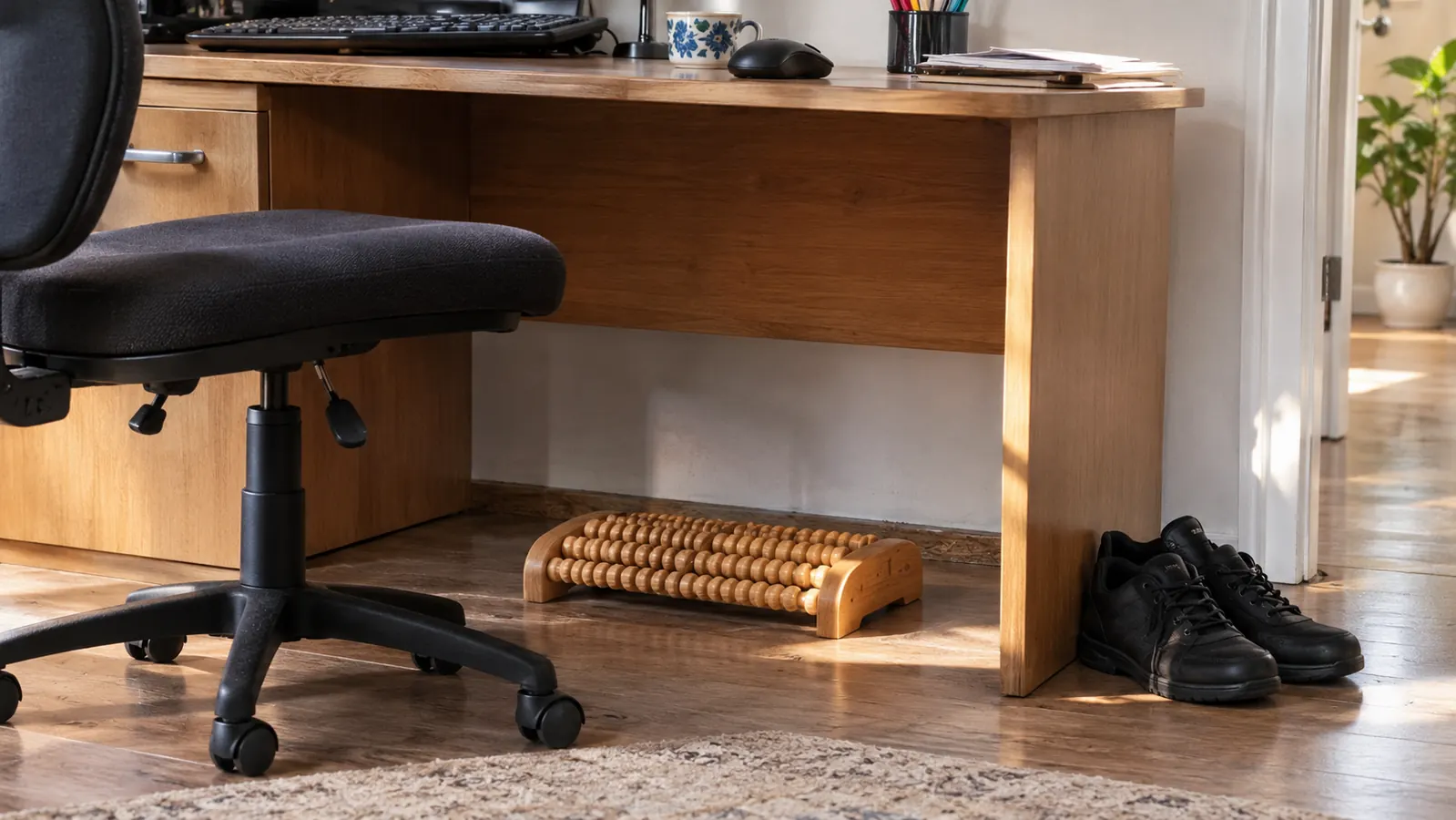
The insoles are in the work sneakers and they stay there. Full length, firm, high arch, trimmed along the cutting line to fit, and they carry the concrete shift. The compression socks go under the same sneakers, every shift, nowhere else. They are toeless ankle sleeves, so my toes are bare inside the shoe, and the snug feel took about a week to stop noticing. The calf stretcher is a rubber foot rocker that lives on the bathroom floor beside the counter. Three holds of thirty seconds per leg every morning before shoes, one hand on the counter for balance. The foot roller is at work, under the back office desk, five minutes at lunch with my shoes off. It feels good for an hour and I claim nothing past that.
The point is that each thing has a lane. Insoles and socks are for the shift. The stretcher is for the morning. The roller is for lunch. The sandals are for home. When I stopped expecting one purchase to solve everything, I also stopped being annoyed at products for failing at jobs I had invented for them.
By the second week I had stopped thinking about them, which is the highest compliment I can give a piece of footwear.
Six months in, they are still the first thing my feet touch
Not a cure, not a shoe, and not a substitute for a doctor. They are a slide with arch support that sits beside my bed and makes the first ten minutes of the morning softer. If your mornings start the way mine did, that may be worth a look.
Amazon Check Today's Price on Amazon →