
The first thing I do in the morning is not stand up. I sit on the edge of the bed, put both feet flat on the carpet, and wait a second to find out what the left heel is going to say. It has been saying something since October 2025. Some mornings it is a mild ache that fades by the time the coffee is made. Fewer mornings now, but still some, it is the old sharp stab that used to make me grab the doorframe. I am 59. I manage the office and work the floor at a family hardware store in Medford, Oregon, and Tuesday through Friday I spend most of nine hours on concrete in one pair of plain black lace-up work sneakers I have worn since 2024.
What I have figured out is that the shoe gets all the attention and the sock gets none, which is backwards when you stand for a living. In April 2026 I bought two pairs of SB SOX compression socks, the ankle kind that leave the toes bare, and they have become the thing I notice least and miss most on the days I forget them. I am not going to tell you they were the answer to my heel. They were not, and my heel is better than it was in the winter but it is not gone. What follows is how I wear them, in what order, and where I think they stop helping. Feet differ. Yours are not mine, and Dr. Okafor would tell you the same thing.
The pair I put on before my feet touch the floor
Two pairs of SB SOX ankle compression socks, bought in April 2026 and worn under one pair of work sneakers every shift since. They size by arch measurement rather than shoe size, so that number is the first thing to check.
Amazon Check Today's Price on Amazon →What I Do, In Order
Step 1: Measure your arch, not your shoe size
SB SOX sizes these by arch measurement in inches, not by shoe size: small for a 5 to 8 inch arch, medium for 7 to 10, large for 9 to 13, and extra large for 12 to 15. That is an odd way to buy a sock if you are used to grabbing a package off a peg, and it is the reason I did not guess. Don held a soft tape around the arch of my left foot on a Saturday morning while I stood with my weight on it, and we wrote the number on the back of an envelope and took it to the computer.
The ranges overlap on purpose, and the overlap is where most of us land. If your number sits near the top of one range it also sits near the bottom of the next, so at that point the choice is not really about inches. I would rather have the snug end of a range than buy up to be safe. Snug is the entire point of a compression sock, and a loose one does nothing except slide down inside your shoe all day and bunch under the arch.
One thing I would add, having done this twice. Measure at the end of the day, not the morning, because a foot that has been walked on for nine hours is a different foot from the one you woke up with. My evening number came out a shade larger than the Saturday morning one, not enough to change my size, but enough that I was glad I checked rather than assuming. And measure both feet even if only one of them is the problem. My right foot has never hurt and it still needed a number, because you wear the socks in pairs and a mismatched fit on the good foot is its own small annoyance by two in the afternoon.
Step 2: Put them on sitting down, before you stand up
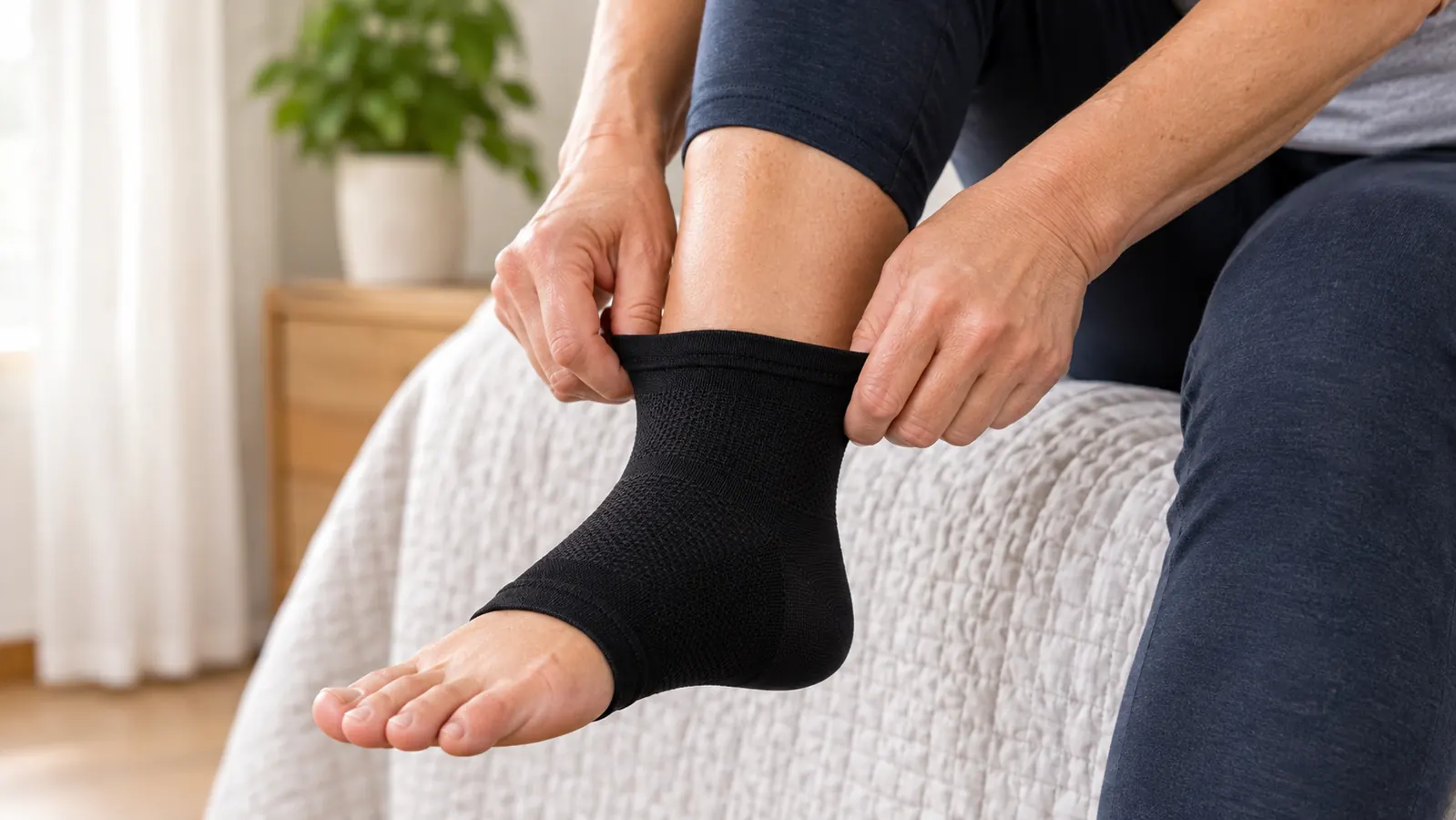
The order matters more than I expected. I sit on the edge of the bed, work the sock up over the arch with both thumbs, smooth the band so it sits flat, and only then put my feet on the floor. On the mornings I stand first and dress afterward, the first steps are worse, and the sock cannot undo what has already happened. It is preparation, not rescue. That single change in sequence did more for my mornings than any amount of fiddling with the sock afterward.
There is no strap, no closure, no fastener. It is pull-on, which means your hands do the work. Roll it up from the bottom rather than hauling on the top edge, and do not snap the band against your ankle to get it into position. The first week I fought mine every morning. The second week I had a method and stopped thinking about it.
I will tell you about the morning I got it wrong, because it taught me more than the mornings I got it right. A Thursday in May, running late because Don had left the truck blocking the driveway, so I pulled the sneakers on barefoot, socks in my hand, and put them on standing in the kitchen with one foot up on the tile. The first four steps to the door were the worst they had been in weeks, and the sock I wrestled on after that never sat right all day. The band rolled. It was not the sock being wrong. It was me doing it twelve minutes too late in the wrong order. I have not done it since.
Step 3: Wear them inside the shoes you actually wear
Mine go under the work sneakers, every shift, and nowhere else. Not with the slides at home, not on the Sunday walk with Don. The reason is plain: the sneakers are where the concrete gets its chance at me, so that is where the extra layer needs to be. A compression sock worn with a slipper is a sock doing nothing in particular.
I have never slept in them. I know people do, and I am not going to argue with anyone's routine, but my own rule is that the sock comes off when the shoes come off. My feet get a plain, un-squeezed eight hours and I get to start the morning fresh. That is comfort logic, not medical logic, and I want to be clear about which one I am handing you.
The most honest thing I can tell you is about the inventory Saturday in late June 2026. Eleven hours, most of it on concrete, and I had the socks on the entire day. My heel flared anyway and stayed angry for about three days. They are not armor. They do not cancel out a bad day, and if you buy them expecting to be immune to an eleven hour shift you will be disappointed, and it will not be the sock's fault.
The shoes matter here too, and I am not going to pretend otherwise. My sneakers have been on my feet since 2024 and the laces are the original ones. What I found is that I lace them looser across the top of the foot and firmer down near the toe than I used to. Tight lacing over a snug sock gives you a hot spot across the instep by mid morning, and I had two weeks of that before I understood it was the lacing and not the sock. If your work shoes are already a half size too tight, the sock will not fix that. It will find it.
Step 4: Give the snugness a week
The first few days the sock felt like an opinion being expressed about my ankle. Not painful, just present. I noticed it every time I crouched to reach a bottom shelf, and I noticed it when I stood back up. By the end of that week I had stopped noticing it, and that has been true ever since. If you try one on for ten minutes at home and decide it is not for you, you have not really tested it yet.
I bought two pairs so one is always dry. They go through the machine wash with the rest of the laundry and I hang them to air dry rather than putting them in the dryer. Seven months in, the band on both pairs still sits flat and the fabric has not gone slack. Machine washing something this snug sounds like it should wear it out faster than it does, and I have been pleasantly wrong about that.
Specifics, since I always want them from other people. The label says machine wash, and the fabric is nylon and spandex, which is why the dryer is the one step I skip. I wash them Friday evening with the work shirts, they hang on the rail over the laundry sink overnight, and they are dry by Saturday morning. The pair I bought in April has been through that cycle somewhere north of thirty times. The band still sits where I put it. The fabric across the arch has not thinned. That is a small thing to be pleased about and I am pleased about it anyway, because I expected to be buying replacements by now.
Step 5: Keep the sock in its lane
This is the part I would underline twice. The sock does one job in my routine: it goes under the work sneakers every shift. It is not a replacement for the insoles in those sneakers, and it is not a replacement for the morning stretch. When I stopped treating it as the whole answer and started treating it as one more piece, my mornings got more predictable. That took me a couple of months to accept.
The division of labor in my house is set now. The PCSsole insoles live in the work sneakers and go nowhere else. The ProStretch rocker stays on the bathroom tile and I do three holds of 30 seconds per leg every morning before shoes, one hand on the counter. The TheraFlow roller sits under the back office desk and I use it about five minutes at lunch with my shoes off. The slides stay beside the bed for the first steps of the day. Each one has its spot, and none of them is doing another one's work.
And here is where I stop being useful to you. Numbness, tingling, swelling, a foot that is hot or looks different from the other one, a sudden injury, or heel pain that will not settle: those are not sock problems, and they are not something to troubleshoot in a hardware store stockroom. I saw Dr. Okafor in December 2025 and again in April 2026, and that is the whole of my history with this. Go see someone who can actually look at your foot.
What Else Helps
If the sock is the only thing you change, you get the smallest version of the result. The morning calf stretch did more for my first steps than anything I bought, and it cost nothing. I had been doing a wall stretch since December 2025 and added the rocker in February 2026, and my calves felt looser after about four weeks. Three holds, 30 seconds each leg, before shoes. That is the entire routine, and I do it on the tile with one hand on the counter because that is where the light is good.
The second thing is the surface under your feet at home. The first steps of the day happen on whatever is beside your bed, and for me that was bare feet on carpet and then bare feet on kitchen tile ten steps later. The slides were an attempt to stop making the worst twenty minutes of my day worse on purpose. It felt softer on the tile from the first morning. I call that comfort and nothing more, and I would not let anyone sell it to you as anything bigger than that. The Sunday loop with Don, 1.5 miles on pavement, is the part I would keep if I had to give up all the rest.
What I would skip, if you are making a list and working down it: anything that promises to replace the boring parts. The boring parts are the ones that worked for me. Three holds on the tile every morning. A sock on before the feet hit the floor. A number measured with a soft tape instead of a guess at the package. None of that is interesting and none of it can be bought in a single afternoon. Seven months in, my mornings are a mild ache most days instead of the stab they were in January, and I credit no single thing for that. The socks are the piece I would replace first, and the stretch is the piece I would never drop.
The socks did not change my heel. They changed the middle of a shift, which turned out to be most of my life.
Two pairs, one work week, and a number worth measuring first
The SB SOX ankle socks are the piece of my routine I would replace first if I lost it. They are not the answer to a bad heel and they were never sold to me as one. They are what makes nine hours on concrete feel less like a negotiation. Check the arch measurement before you order.
Amazon Check Today's Price on Amazon →